

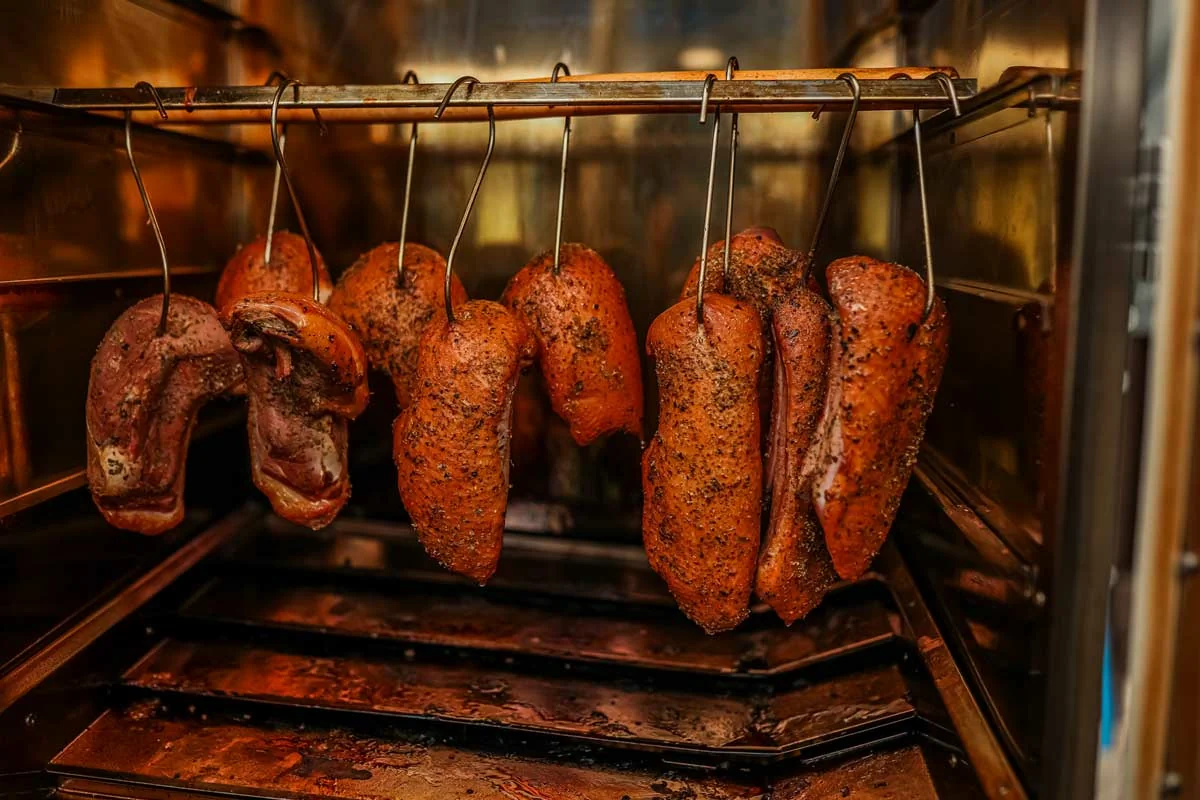
Choosing the right smoker depends mainly on what you want to prepare most often: homemade cold cuts, bacon, sausages, fish, cheese or classic BBQ dishes. A gas grill, kamado, pellet smoker, simple wooden or metal smoker and an electric smoker can all deliver very good results, but they differ in operation, temperature control, smoke generation and the amount of attention required during the process.
Quick answer: which smoker is best for a beginner?
For someone who wants to start smoking without constantly tending a fire and manually adjusting the temperature, one of the most practical solutions is an electric smoker with a separate smoke generator.
Separating the heat source from the smoke source allows temperature and smoke intensity to be controlled independently. This makes it easier to achieve repeatable results when smoking fish, meat, sausages, bacon or cheese.
Traditional wooden and metal smokers still have many enthusiasts and can produce excellent results, but they usually require more experience and more frequent process control. Kamado grills and charcoal grills are excellent for grilling and BBQ and can also be used for smoking, but they require control of the charcoal, airflow and temperature. They are not, however, typical devices for cold smoking.
Key points
If you want to smoke meat, sausages and fish
Look for a device that maintains a stable temperature and allows you to control the amount of smoke. With trout, mackerel, bacon, pork loin or sausages, proper product preparation, process control, hygiene and internal food temperature are all important where applicable.
If you mainly want to grill
A gas grill, charcoal grill or kamado will be a more natural choice. They can also be used for smoking and BBQ, but the way the process is managed differs from working with a dedicated smoker.
Comparison of smoking and BBQ equipment
| Device | Best suited for | Biggest advantage | Main limitation |
|---|---|---|---|
| Gas grill | Grilling, quick cooking, homemade grilling sausages | Convenience, fast heat-up and high temperature | Not designed for regular traditional smoking or cold smoking |
| Kamado | Grilling, baking, BBQ and hot smoking | Excellent heat retention and versatility | Requires fuel and airflow control; not a typical cold-smoking device |
| Simple wooden smoker | Traditional smoking for people who enjoy managing the process manually | Classic smoking method and direct involvement in the process | Temperature and smoke control require experience |
| Simple metal smoker | Basic smoking on a limited budget | Low entry cost and simple construction | With poor insulation, internal temperature can be strongly affected by weather conditions |
| Pellet smoker | Ribs, pulled pork, brisket and other BBQ dishes | Automatic temperature control and convenience during long BBQ sessions | Minimum operating temperature is usually too high for cold smoking, while heat and smoke come from the same fuel source |
| Water smoker | Low & slow BBQ | Simple construction and very good results once mastered | Requires fuel and temperature control; not convenient for cold smoking |
| Charcoal grill with lid | Grilling, BBQ and shorter smoking sessions | Versatility and relatively low entry cost | Limited space and the need to control charcoal and airflow |
| Borniak electric smoker | Cold, warm and hot smoking, fish, meat, sausages, cheese, BBQ and drying | Independent temperature and smoke control plus a wide range of applications | Does not replace a grill for direct high-heat searing over a flame |
Gas grill vs smoker
A gas grill is a convenient and versatile appliance. It heats up quickly, allows easy temperature adjustment and works very well for everyday grilling.
Wood chip boxes or smoking tubes can also be used to add smoke flavour. This does not replace a traditional smoker, but it creates interesting possibilities for combining grilling with a short smoking stage.
Make your own sausage for the grill
One interesting option is to prepare your own fresh sausage specifically for grilling. You choose the meat, spices and recipe yourself, so you can make a sausage exactly the way you like it.
The sausage can first be lightly smoked and then finished on the grill. This combines the flavour of natural wood smoke with the characteristic browning and searing produced by grilling.
For fresh sausages intended for direct grilling, recipes can be used without nitrite curing agents where those agents are not required for that particular type of sausage and preparation method.
If you regularly prepare sausages, bacon, hams, fish or cheese, however, a dedicated smoker offers much greater flexibility. A gas grill and a smoker do not have to replace one another — they can complement each other extremely well.
Kamado
A kamado is an extremely versatile cooker. It performs very well for grilling, baking and BBQ and can also be used for smoking.
Its ceramic construction retains heat very effectively, but when smoking, the user still needs to manage the fire, fuel quantity and airflow.
In a kamado, glowing charcoal is the heat source, while smoke is generated as part of the combustion process. This means there is no true independence between heat and smoke generation, unlike in a smoker equipped with a separate smoke generator.
A kamado works very well for hot smoking and BBQ. It is not, however, a typical solution for cold smoking, where smoke is required with very little increase in chamber temperature.
Pellet smoker
A pellet smoker is designed primarily for BBQ and long low & slow cooking. It works particularly well for ribs, pulled pork, brisket, poultry and other dishes that require several hours of controlled cooking.
An automatic pellet feeder and electronic temperature control significantly reduce the amount of manual attention required.
It is important to remember, however, that the pellets are responsible for generating both heat and smoke. Minimum operating temperature depends on the model and, in many popular pellet smokers, is around 75–95°C.
For this reason, pellet smokers are excellent for BBQ and hot smoking, but they are not designed for traditional cold smoking.
Water smoker
A water smoker is designed mainly for low & slow BBQ. Once fuel and airflow control have been mastered, it can deliver excellent results with ribs, large cuts of meat or poultry.
Like a kamado, however, it uses a fire as the heat source, so the process is managed differently from a smoker equipped with an independent smoke generator.
Why is independent control of heat and smoke important?
Temperature and smoke intensity do not always need to change at the same time. Depending on the product, you may need more smoke without increasing the temperature, or you may want to continue cooking without adding more smoke.
When you need smoke
The smoke generator can operate independently from the heater. This allows you to smoke food without automatically increasing the chamber temperature.
When you only need heat
The smoke generator can be switched off while cooking continues using the heater alone. This is particularly useful during the final stages of smoking and during BBQ.
In a Borniak smoker, the heater and smoke generator operate as two separate systems. This makes it easier to adjust the process to the specific product being prepared.
Borniak automatic smoke generator
The Borniak smoke generator uses natural smoking wood chips and automatically feeds them into the smouldering zone. This means there is no need to keep adding wood or manually maintain a fire throughout a long smoking session.
The wood chip hopper provides around 8 hours of operation, which is usually enough to complete an entire smoking process without refilling.
The smoke generator can be switched on or off at any time independently from chamber heating. This allows you to decide exactly when the food should be exposed to smoke.
Different types of natural wood can be used for smoking. Wood chips can also be mixed to create custom flavour profiles for meat, fish, cheese and other products.
Borniak smoker and BBQ
A Borniak smoker is not limited to traditional smoked meats, sausages, fish or cheese. It also performs very well for low & slow BBQ.
In suitable models, temperatures can reach approximately 150°C, making it possible to prepare ribs, pulled pork, brisket, poultry and other dishes that require several hours of cooking at a controlled temperature.
Borniak and pellet smoker — similar applications, different operating principles
Both a pellet smoker and a Borniak smoker are very well suited to low & slow BBQ. The main difference is how heat and smoke are generated.
In a pellet smoker, burning pellets both heat the cooking chamber and generate smoke. In a Borniak smoker, an electric heater controls chamber temperature while a separate generator produces smoke.
During BBQ, this allows you, for example, to expose the meat to more smoke at the beginning of the process, then reduce or completely stop smoke production and continue cooking for several hours at a stable temperature.
The same smoker can therefore be used for traditional sausages, hams, fish and cheese as well as classic BBQ dishes.
Why is temperature control so important?
Smoking is not only about smoke. The final result depends on the entire process: curing or salting, drying, smoking, possible heat treatment and then cooling and proper storage.
Stable temperature helps make the process more predictable, but it does not replace correct food preparation, hygiene or monitoring of internal food temperature.
Typical smoking temperature ranges
The values below are approximate. The correct temperature and processing time depend on the product, the way it has been prepared and the specific recipe being followed.
| Method | Typical temperature range | Example applications |
|---|---|---|
| Cold smoking | approx. 16–25°C | Selected cured meats, bacon, cheese and properly prepared fish |
| Warm smoking | approx. 30–60°C | Fish, selected meats, cheese and other products |
| Hot smoking | approx. 60–120°C | Fish, meat, sausages, poultry and selected BBQ dishes |
| BBQ / low & slow | Depends on the product and device | Ribs, pulled pork, brisket, poultry and large cuts of meat |
How to choose the right device for your needs
| Your goal | Recommended direction | Why |
|---|---|---|
| Homemade cured meats, bacon and sausages | Electric smoker | Independent temperature and smoke control plus repeatable processes |
| Trout, mackerel and salmon | Electric smoker or a well-mastered traditional smoker | Good control of temperature and smoke intensity |
| Cold smoking | Smoker with an independent smoke generator | Smoke can be generated without having to run a fire that heats the chamber |
| Ribs, pulled pork and brisket | Borniak BBQ smoker, pellet smoker, kamado, offset smoker or water smoker | Devices suited to long low & slow BBQ cooking |
| Grilling steaks, burgers and sausages | Gas grill, charcoal grill or kamado | High heat and direct searing capability |
| Starting with little experience | Electric smoker | Fewer variables to manage than with manually controlled fire, charcoal and smoke |
| Traditional fire management | Wooden smoker, metal smoker, offset smoker or kamado | Greater direct control over fuel, fire and the smoking process |
When does a Borniak smoker make the most sense?
A Borniak smoker is particularly practical when you want to prepare different types of food and use several cooking and smoking techniques in one device.
- You want to smoke sausages, hams, bacon, fish or cheese.
- You want to use cold smoking.
- You prepare ribs, pulled pork, brisket and other BBQ dishes.
- You want independent control of temperature and smoke.
- You do not want to spend hours manually tending a fire.
- You want to be able to repeat a successful smoking process.
- You prepare larger batches of food.
When is a grill the better choice?
If you mainly prepare steaks, burgers, vegetables or sausages that require high heat and direct searing, a gas grill, charcoal grill or kamado will be the more natural choice.
A smoker and a grill do not have to compete with each other. In many applications they complement each other very well — food can first be smoked and then finished on the grill.
Checklist before buying a smoker
- Decide whether you will most often prepare fish, cured meats, sausages, cheese or BBQ dishes.
- Check whether the device supports cold, warm and hot smoking.
- If BBQ is important to you, check the maximum operating temperature.
- Pay attention to chamber insulation and temperature control.
- Check whether smoke generation can be controlled independently from the heat source.
- Check chamber capacity, especially if you plan to prepare larger batches of sausages, meat or fish.
- Consider how easy it is to clean grease, condensation, ash and smoke-generator components.
- Do not choose based on price alone. Range of applications, process control, convenience and repeatability are equally important.
Summary
There is no single device that is best for every type of outdoor cooking. If you mainly grill steaks, burgers or sausages, a gas grill, charcoal grill or kamado will be the natural choice.
A kamado can also be used for smoking and is excellent for BBQ, but it requires fire management and airflow control.
A pellet smoker is a very convenient device for low & slow BBQ. It automatically feeds fuel and maintains temperature, but pellet combustion is responsible for both heat and smoke, and the minimum operating temperature of many models is too high for traditional cold smoking.
A Borniak smoker combines traditional smoking with BBQ. A separate electric heater and smoke generator make it possible to control temperature and smoke independently.
As a result, one device can be used to prepare sausages, hams, bacon, fish and cheese as well as ribs, pulled pork, brisket and poultry. It is a practical solution for people who want to use different smoking and BBQ techniques without having to constantly manage a fire.
FAQ
Can you smoke food on a gas grill?
A gas grill can be used for short smoking sessions with wood chips or suitable smoking accessories. It does not, however, replace a dedicated smoker for regularly preparing sausages, hams, fish or cheese.
Can you make your own sausage for the grill?
Yes. You can prepare fresh sausage using your own recipe, choose the meat and spices yourself, then lightly smoke it and finish it on the grill. This gives you complete control over the ingredients and flavour.
Can you smoke food in a kamado?
Yes. A kamado works very well for hot smoking and BBQ. It is not, however, a typical cold-smoking device because a live charcoal fire is used as the heat source.
What is the difference between a Borniak smoker and a pellet smoker?
In a pellet smoker, the pellets provide both chamber heat and smoke. In a Borniak smoker, the electric heater and smoke generator are separate systems, allowing temperature and smoke production to be controlled independently.
Is a Borniak smoker suitable for BBQ?
Yes. Suitable models can be used for long low & slow BBQ sessions and for preparing ribs, pulled pork, brisket and poultry. The independent smoke generator also allows you to decide how long the food should be exposed to smoke.
Can a pellet smoker be used for cold smoking?
A standard pellet smoker is primarily designed for BBQ and hot smoking. Minimum operating temperature depends on the model and is around 75–95°C in many devices, so traditional cold smoking generally requires a different solution.
Is an electric smoker good for beginners?
Yes. Temperature control and an automatic smoke generator reduce the number of tasks the user must manage during the process. Basic knowledge of product preparation, drying, hygiene and safe heat treatment is still essential.
Can you smoke cheese in a Borniak smoker?
Yes. The ability to generate smoke independently from chamber heating is particularly useful for products that require low temperatures, such as cheese.
Does more smoke mean better flavour?
No. Too much smoke can produce an overly intense or bitter taste. Smoke intensity should be matched to the product, its size and the stage of the process.
Can a smoker replace a grill?
Not for every application. A smoker is excellent for smoking and low & slow BBQ, while a grill is better for direct searing at very high temperatures. The two devices can complement each other very well.